
By Theano Manou
In the early-to-mid 20th century, hotels in America operated either under Jim Crow laws of segregation or, in some states, through “customs” that excluded African Americans form white-owned establishments. To navigate this hostile landscape, Victor H. Green published The Negro Motorist Green Book (1936–1966), which listed hotels and other public spaces “that were known to be safe ports of call for African American travelers” (Andrews n.p). Hotels, then, became racially and politically charged spaces. As Athanasios Dimakis observes, they “define[d] the experience of race in modernity” (3).
Nella Larsen emerged in the midst of the Harlem Renaissance (1918-1935), publishing only a few short stories and two novels and disappearing from the public eye shortly after. In her novels, Quicksand (1928) and Passing (1929), Larsen deals with themes concerning the fluidity of racial identity and the act of “passing” as white. “Passing” is defined by Emily Nix and Nancy Qian as the practice in which a person is expected to “have physical features that are commonly shared by Caucasians, to behave and dress like a white person and associate. Thus, passing required a person to move to a white community, where the “passer” was not previously known by others as black” (12). Passing, therefore, had more to do with the community you were associated with rather than physical features (12), that could easily be dismissed as Caucasian.
In Passing, Larsen introduces and explores the theme of racial passing through the setting of the Drayton Hotel, where her protagonists, Irene Redfield and Clare Kendry, two light-skinned Black women, are allowed access as they are perceived as white. The fictional hotel offers the space for the characters to explore their fluid identities and grapple with the psychological consequences of passing while navigating the discriminatory landscape of the hotel. The novel opens with Irene reminiscing her visit to Chicago, where she seeks refuge from the summer heat and an escape from “contact with so many sweating bodies” (Larsen 9) by entering the Drayton Hotel, a hotel modelled after the historic luxury establishment known as The Drake Hotel. She “went in through the Drayton’s wide doors” (10), crossing the threshold into an all-white, exclusive space and away from the working-class mass that seems to upset her. As she ascends to the rooftop, Irene describes the experience as “being wafted upward on a magic carpet to another world” (10). And these upper floors of the Drayton are indeed “another world”; one where Irene is granted access only because she can temporarily transgress her identity as a Black woman and pass as white. Her ascent on the elevator is reminiscent of Gabriel Dan’s in Joseph Roth’s novel Hotel Savoy (1924), where, as Chryssa Marinou notes “the character’s perception of the lift ride stands for an imaginary, if momentary, ascending of the social ladder” (69). Similarly, Irene’s upward movement is a performance, an illusory entry in a world of racial privilege.
Irene is not only “passing” as a white woman, but she is also performing her role as part of the upper-middle class. This performance of race and class is possible as “it is the anonymity and plasticity of the hotel spirit that lets them assume false identities” and their “transgressions become permissible” (Dimakis n.p.). The hotel, therefore, enables this kind of fluidity of identity as it functions as a Foucauldian heterotopia: “not freely accessible like a public space” (Foucault 26) but governed by the rules and racial hierarchies of the Jim Crow era, in which Black people were systematically excluded from certain public and private spaces, as well as on class expectations: a white person but of working class background or appearance would not be allowed to the Drayton’s roof for tea. Irene’s presence, therefore, in this space is possible because of her ability to “pass,” to embody a racial and social identity that grants her entry in this space. As Michel Foucault explains, to get in such a heterotopic space, “one must have a certain permission and make certain gestures” (26). Irene possesses both; her lighter skin, along with the self-assured way she carries herself, serves as that permission. She performs whiteness convincingly enough so that her presence in this segregated space goes unquestioned.
The hotel theatrics, however, do not last long. Irene’s security in her performance is challenged under Clare Kendry’s gaze. As Jennifer DeVere Brody argues, it is significant that Clare, an old friend and another black woman also passing as white, is the one to unsettle Irene’s confidence and not any other white person. “It is proof that Irene wishes to distance herself from her background while Clare wishes to collapse the distance between her own appearance and her current chosen position” (Brody 1059). Ultimately the two women project their desires onto one another; Coming from a poor background, Clare passes as white to escape her class rather than her heritage. When talking to Irene, she reveals the reasons she risked permanently passing: “I was determined to get away, to be a person and not a charity…You had all the things I wanted and never had had” (29). Clare did not want to be pitied for her race by her Christian aunts, and she envied the middle-class upbringing Irene had; therefore, her passing was not a choice made to escape her Black roots, but rather an attempt at social climbing that could be accomplished only if she passed over to white society. Clare, thus, forces herself into Irene’s life to reconnect with her roots, to fall back to her black past.
Irene, on the other hand, passes in order to escape the restraints of her black identity. For Irene, Clare Kendry is not only a reminder of her past and an intrusion in her life but also a manifestation of what could have been had she fully passed as white. At times, we see Irene resenting her race, wishing “she had not been born a Negro” (130) or embracing more the American over the African part of her hyphenated identity: “She belonged in this land of rising towers. She was an American” (145). Clare Kendry then is a projection of Irene’s desire to be closer to whiteness. And what they both embody is what W.E.B. Du Bois calls “double consciousness”, the inner struggle of the African American to balance the dual identity of their African roots with their American identity. As Du Bois writes:
It is a peculiar sensation, this double-consciousness, this sense of always looking at one’s self through the eyes of others, of measuring one’s soul by the tape of a world that looks on in amused contempt and pity. One ever feels his twoness, —an American, a Negro; two souls, two thoughts, two unreconciled strivings; two warring ideals in one dark body, whose dogged strength alone keeps it from being torn asunder (3).
This “two-ness” is embodied in the way Clare and Irene mirror one another. For Irene, Clare is a fantasy made real; she has managed to seemingly escape what Irene calls the “burden of race” (Larsen 130) and the burden of Black womanhood by embracing fully the privileges of whiteness. For Clare, Irene has what she cannot have: a secure black identity, a community, a family, without having to sacrifice part of herself. Clare enters Irene’s life not because of nostalgia, but because she wants to reclaim her Black identity. In this process, each woman becomes the other’s “white gaze,” a reflection of the societal lens they both navigate.
The performance of passing that begins with Irene’s upward movement to the roof of the Drayton Hotel ultimately ends with Clare’s fatal fall from a window. The building where Clare falls from resembles a hotel: it hosts a public party, making her death both a tragedy and a spectacle. The novel, therefore, ends where it began; in a heterotopic, liminal space where the protagonist is faced with the “in-betweenness” of her identity that facilitates passing. As Cheryll A. Wall notes, “Larsen’s protagonists assume false identities that ensure social survival but result in psychological suicide” (Wall 98). Clare has survived by successfully masquerading as a white woman, but she dies as a Black woman, right after her true racial identity is exposed to her husband. She seems either unaware of the danger or unbothered by it; Irene observes that “there was even a faint smile on her full, red lips, and in her shining eyes” (Larsen 150), suggesting a sense of peace or release. This is her last “passing” and as she passes away her final transgression is complete. Clare’s fall can be read as either a final escape from the duality she could no longer maintain, or if we assume that Irene pushed her, it could be read as an erasure of her mirrored self, her black identity that she subconsciously resented. Either way, the Drayton Hotel, as a heterotopic space, marks the beginning of a descent into fragmentation; the “two-ness” of identity cannot be reconciled without a cost.
Works Cited:
Alexander, Otis. “The Harlem Renaissance (1918-1935).” BlackPast.org, 9 June 2025, www.blackpast.org/african-american-history/the-harlem-renaissance-1918-1935.
Andrews, Evan. “The Green Book: The Black Travelers’ Guide to Jim Crow America HISTORY.” HISTORY, www.history.com/articles/the-green-book-the-black-travelers-guide-to-jim-crow-america.
Brody, Jennifer DeVere. “Clare Kendry’s ‘True’ Colors: Race and Class Conflict in Nella Larsen’s Passing.” Callaloo, vol. 15, no. 4, Jan. 1992, p. 1053-1065. https://doi.org/10.2307/2931920.
Dimakis, Athanasios. “‘Ma Soul’s a Witness for De Waldorf-Astoria!’ Langston Hughes’s Poetic Hotel Advertisement.” The Explicator, vol. 81, no. 3–4, Oct. 2023, pp. 128–31. https://doi.org/10.1080/00144940.2024.2327452
—. “O. Henry’s Manhattan Hotel: Mamie Siviter (Madame Heloise D’Arcy Beaumont) and James/Jimmy McManus (Harold Farrington) as ‘Transients in Arcadia’ – Hotems Project.” https://hotems.enl.uoa.gr, https://hotems.enl.uoa.gr/o-henrys-manhattan-hotel-mamie-siviter-madame-heloise-darcy-beaumont-and-james-jimmy-mcmanus-harold-farrington-as-transients-in-arcadia/
Du Bois, W.E.B. The Souls of Black Folk. 1903. PDF file, https://faculty.uml.edu/sgallagher/WEBDuBois-Souls_of_Black_Folk-1-14.pdf.
Foucault, Michel. “Of Other Spaces.” Diacritics, Jan. 1986, p. 22-27. https://doi.org/10.2307/464648.
Larsen, Nella. Passing. Penguin Classics, 2022.
Marinou, Chryssa. “Joseph Roth’s Hotels in the 1920s: The Displaced Male Subject After World War I.” Literary Geographies, Mar. 2022, pp. 64–77. https://www.literarygeographies.net/index.php/LitGeogs/article/view/309
Nix , Emily, and Nancy Qian. The Fluidity of Race: “Passing” in the United States, 1880-1940. 1 Jan. 2015, https://doi.org/10.3386/w20828.
Wall, Cheryl A. “Passing for What? Aspects of Identity in Nella Larsen’s Novels.” Black American Literature Forum, vol. 20, no. 1/2, Jan. 1986, p. 97-111. https://doi.org/10.2307/2904554.
Theano Manou is a final-year undergraduate student of English Language and Literature at the National and Kapodistrian University of Athens. She is interested in contemporary and postmodern literature and political fiction.

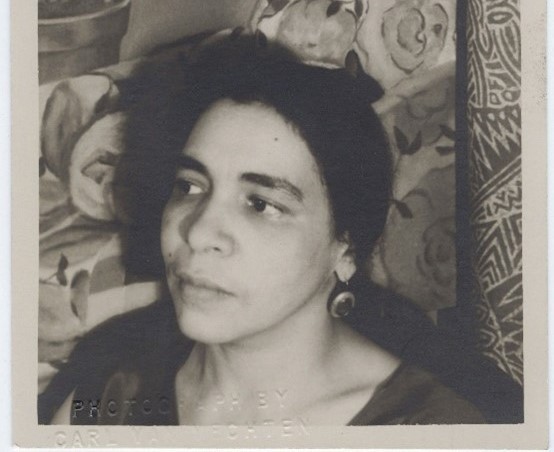
Nella Larsen From the Collection: Van Vechten, Carl, 1880-1964
Published on March 26, 1932
Source: Yale University Library https://collections.library.yale.edu/catalog/2025902

The Drake Hotel in Chicago Postcard from 1920
Source: Wikimedia Commons: https://collections.library.yale.edu/catalog/2025902


This was an extremely interesting read! Thank you Theano for sharing!!