
By Elena Diasiti
James Baldwin was a prolific novelist, essayist and political spokesperson who, through his works, sought to forge a place for the condition of marginalisation that he had experienced as a black, impoverished artist and a gay man (Abur-Rahman 477). Baldwin critiqued the American attachment to “immaculate manliness”, which is always intertwined with an “immaculate whiteness” (Thomas 612-613). He foregrounded the black experience in the US, which often masked his “true subject”, which was sexual conflict (Maxwell 44). Giovanni’s Room (1956) is a novel that abandons racial overtones and focuses on homosexual desire, something that initially deemed it indecent by the New York presses, which dismissed it altogether. The room of the title is heavily inspired by Baldwin’s time in Paris, where he lived in a “gay apartment” with Elliott Stein, a studio in the Hôtel Verneuil, characterised by its “parodic queer excess”, a parallel to the chaos and hyper-aestheticism of the fictional room (Maxwell 37, 39).
Giovanni’s Room is a poignant exploration of the destructive impact of societal expectations and privileges, which lead to self-denial. It addresses issues such as the performativity of the “straight man”, as David, the protagonist, relies upon his engagement with a woman, Hella, to validate his publicly perceived heterosexuality, while inwardly he struggles with the alienation this pretence creates. The only space that initially seems to accommodate his hidden homosexual desire becomes a maid’s room at the far end of Paris, inhabited by his secret lover, Giovanni. This room becomes an in-between space where David can transform into the man he cannot outwardly display, taking on different roles that shatter his fixed ideas of masculinity, and at the same time, it functions as a metaphorical closet that eventually brings about the tragedy of repression and Giovanni’s death.
While the maid’s room where Giovanni and David cohabit is not a hotel in its literal sense, it operates as one on a psychological level. Similar to the novel’s many temporary interiors (bars, rented apartments, hotel rooms), it functions as a transient space that encapsulates the secrecy and impermanence of the two men’s affair, while simultaneously denying the possibility of it ever being stabilised. Therefore, despite technically being a residence, the maids’ room does not function as one; rather, it serves as a temporary dwelling, a fragile setting for love, which David quickly abandons when his feelings for Giovanni become unbearable. The temporary room makes commitment structurally impossible, just as in a hotel, departure is always assumed. Giovanni’s room must be abandoned, for in the “straight mind”, a life with another man can only exist in a state of existential dislocation, characterised by a lack of viable future, impossibility, or unintelligibility (Butler 174). In the novel, this queer domesticity is not entirely rejected, but rather relocated in a marginal space where it can be accommodated until it upsets David’s deeply rooted heteronormative ideas:
“I can have a life with [Hella].” I stood up. I was shaking. “What kind of life can we have in this room?—this filthy little room. What kind of life can two men have together, anyway?” (Baldwin 126)
The room’s decay also highlights the temporary nature of David and Giovanni’s relationship; much like a rundown hotel past its prime, the bond between the two is doomed to crumble like the room’s walls, despite Giovanni’s futile attempts at renovation –his attempt at permanence. His room is characterised by “clutter and disorder”, which “was not a matter of habit or circumstance or temperament; it was a matter of punishment and grief” (Baldwin 78). This comes into stark contrast with the normalcy of a heteronormative life, the linear temporality of marriage and procreation. David longs for “light and safety”, and his “manhood unquestioned, watching [his] woman put [his] children to bed” (93), as opposed to the room-closet, with painted white windows that isolate him from the heteronormative world. The whiteness of the room also alludes to an asylum or a prison cell rather than a safe domestic space, reinforcing the affect of incarceration. These spaces have historically confined deviancy, aiming to discipline and correct; so Giovanni’s room similarly becomes a site of queer displacement and containment. The sterility and brightness expose David’s illicit desires, causing suffocation rather than offering him refuge.
Viewing Giovanni’s room as a “miserable closet of a room” (Baldwin 126), a materialised queer closet, provides further insight into how it both protects and represses David. It is geographically “out. Far out. It is almost not Paris” (40), creating a sense of detachment and seclusion, similar to the room’s obscured windows. This isolation both protects and threatens, as it traps the two lovers in a place where they have to stay “perfectly silent until whatever seemed to threaten [their] safety had moved away” (76). This creates an opening for David to take on different roles inside and outside the room. Following Butler’s performativity theory, David’s behaviour outside of this haven can be analysed as a series of performances that aim to uphold the illusion of the heteronormative “immaculate manhood”, the straight-acting gay man (Thomas 598). He is rigid and secretive, his actions in society evoking a “long act of dissimulation” conducted through a “mask painted with the social simper” (Sedgwick 205). He is desperate to remain within the “web of safety” that a conventional future with Hella can offer him, to uphold his masculine facade that remains “unquestioned” (Baldwin 92-93). Yet, inside the room, David invents a version of himself that is open and vulnerable, as it evokes this heterochrony, a suspension of heteronormative linearity and normalcy that blurs the sequence of days and the societally assigned roles. Being removed from the expectations of marriage, procreation and respectability allows him to lose himself in the unreal, in a fantasy that disrupts time and dismantles his public persona.
I remember that life in that room seemed to be occurring beneath the sea. Time owed past indifferently above us; hours and days had no meaning. In the beginning, our life together held a joy and amazement which was newborn every day. Beneath the joy, of course, was anguish and beneath the amazement was fear; but they did not work themselves to the beginning until our high beginning was aloes on our tongues. By then anguish and fear had become the surface on which we slipped and slid, losing balance, dignity, and pride. (Baldwin 67)
But even at the moments of joy and freedom, fear still lurked, rendering David unable to negotiate these two performances –the masculine straight man in the public eye and the queer man finding pleasure in “playing housewife” when Giovanni was at work. He is so terrified of this act leaking into the real world and of the loss of his manhood that he decides to treat it like a hotel stay, temporary and transient, “something that had happened to [him] once” (84). David’s terror seems to be explicitly produced not by his love for Giovanni, another man, but rather by the threat of spatial leakage. He enjoys being in the room until domestic routines emerge and queer time starts to resemble ordinary time; hence, it ceases to function as an exception, producing a new identity that threatens to spill into the outside world. The ascribed gender roles are so deeply ingrained in his mind that he quickly rejects this domesticity and asserts, “I am not a housewife —men never can be housewives” (78). He reinforces the binary roles he had just subverted by choosing to revert to his sanctioned role, the “privilege that white middle-class masculinity provides, the privilege of normality” (Thomas 609). He attempts “to burn out, through Hella, [his] image of Giovanni and the reality of his touch” and return to the “steady ground” a life with a woman would provide. So the maid’s room becomes a material manifestation of the closet, one that must be hidden away and, ultimately, abandoned.
David: “What kind of life can two men have together, anyway? All this love you talk about—isn’t it just that you want to be made to feel strong? You want to go out and be the big laborer and bring home the money, and you want me to stay here and wash the dishes and cook the food and clean this miserable closet of a room and kiss you when you come in through that door and lie with you at night and be your little girl. That’s what you want. That’s what you mean and that’s all you mean when you say you love me. You say I want to kill you. What do you think you’ve been doing to me?” (Baldwin 126; emphasis added)
This passage examines not only issues of gendered acts and Giovanni’s perceived misogyny, even within this heteronormative mimicry, but also deeper issues of space and mobility. Although David appears to be feminized, suffocating in the domestic enclosure, while Giovanni is presented as a masculine labourer who moves freely through the city, their reality highlights a deeper asymmetry of power. David panics at the idea that this feminized performance might become permanent, viewing his stay in Giovanni’s room as temporary, as a hotel stay. For Giovanni, however, this room is a necessary condition for his survival. His masculine freedom and mobility are conditional, solely constructed upon labour, youth and desirability. David can enter the room, perform queerness and then exit without consequence. He can reassume his fine-tuned role of “the man” with Hella, keeping his privileges of being a white, heterosexual, middle-class American man intact. Giovanni’s marginalisation, however, is structural and inescapable. Being in Giovanni’s room allows David to imagine oppression, while the world forces Giovanni to live it. The privilege of mobility that David resists within the room is precisely what he possesses outside of it, unlike Giovanni. Therefore, the unevenness of the room’s interstitiality becomes apparent; for David, staying in the room is an arrangement that can be renounced, as he possesses the ability to treat queer domesticity as fleeting and impermanent. For Giovanni, it is the only safe and habitable space. Its forced permanence, however, intensifies his isolation after David’s departure, leading to his mental collapse and fostering the conditions for his destruction and eventual demise.
Works Cited:
Abdur-Rahman, Aliyyah I. “‘Simply a Menaced Boy’: Analogizing Color, Undoing Dominance in James Baldwin’s ‘Giovanni’s Room’.” African American Review, vol. 41, no. 3, 2007, pp. 477-86.
Baldwin, James. Giovanni’s Room. 1956. Penguin Books Ltd, 2004.
Butler, Judith. Gender Trouble: Feminism and the Subversion of Identity. Routledge, 1999.
Maxwell, William J. “Notes on Hotel Camp: Sontag Meets Baldwin in Giovanni’s Room.” James Baldwin Review, vol. 10, 2024, pp. 36-61.
Sedgwick, Eve Kosofsky. Epistemology of the Closet. University of California Press, 1990.
Thomas, Harry. “‘Immaculate Manhood’: The City and the Pillar, Giovanni’s Room, and the Straight-Acting Gay Man.” Twentieth Century Literature, vol. 59, no. 4, 2013, pp. 596-618.
Eleni Diasiti is a graduate of the Department of English Language and Literature of the National and Kapodistrian University of Athens and an aspiring scholar. Her interests include gender and sexuality studies, queer theory and intersectionality.

Collection of the Smithsonian National Museum of African American History and Culture, Gift of The Baldwin Family, Handwritten notes by James Baldwin on Sheraton Tacoma Hotel letterhead. The notes are written on both sides of the letterhead with a headding that reads, “Malcolm’s question…To Be A Citizen.,” Ink on paper, 1320 Broadway Plaza, Tacoma, Washington, United States, https://nmaahc.si.edu/object/nmaahc_2011.99.11.
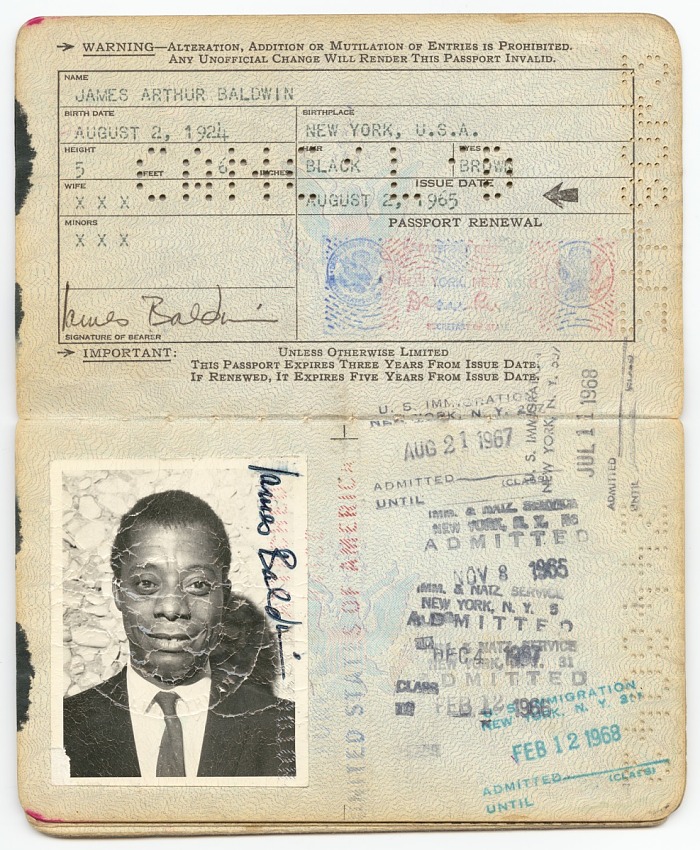
Smithsonian National Museum of African American History and Culture, Gift of The Baldwin Family, United States Department of State, A United States passport (.1) issued to James Arthur Baldwin on August 2, 1965. There is a photograph of Baldwin and multiple immigration stamps with dates ranging from 1965-1968 on the third page. The word [CANC’L’D] is hole punched through the front cover. Two extra passport photographs (.2 and .3) are included with the passport. http://n2t.net/ark:/65665/fd550b23b77-cbc6-4ef1-bb1d-51b5df939c2d


